

.png?mask=1)
Medical Lab Technician
Associate’s Degree of Applied Science
View Catalog
Mission Statement:
The mission of the Medical Laboratory Technician Program at Louisiana Delta Community College is to prepare competent, entry-level Medical Laboratory Technicians who possess the knowledge, technical skills, critical thinking abilities, and professional behaviors necessary to provide accurate, reliable, and ethical laboratory services in diverse healthcare settings. The program is committed to fostering lifelong learning, professional growth, and service to the communities and healthcare systems of Louisiana and beyond.
Program Description:
The Medical Laboratory Technician Program provides students with the scientific knowledge, technical competencies, and professional skills necessary for employment in clinical laboratory settings. Students receive instruction and supervised clinical experiences in Clinical Chemistry, Hematology, Hemostasis, Immunology, Immunohematology, Urinalysis and Body Fluids, Microbiology, and Laboratory Operations. Graduates are prepared to perform diagnostic testing that assists healthcare providers in the detection, diagnosis, treatment, and monitoring of disease processes. Employment opportunities include hospitals, physician offices, clinics, reference laboratories, blood centers, public health laboratories, and research facilities.
Learning Outcomes:
Upon successful completion of the program, graduates will be able to:
- Perform routine laboratory testing procedures accurately and efficiently in accordance with established laboratory protocols.
- Demonstrate competency in Clinical Chemistry, Hematology/Hemostasis, Urinalysis and Body Fluids, Microbiology, Immunology, Immunohematology, and Laboratory Operations.
- Apply scientific principles, laboratory methodologies, and critical thinking skills to the analysis and interpretation of laboratory data.
- Recognize and evaluate pre-analytical, analytical, and post-analytical variables that may affect test quality and patient results.
- Utilize quality control, quality assurance, and quality improvement principles to ensure the accuracy and reliability of laboratory testing.
- Operate, maintain, and troubleshoot laboratory instrumentation according to established procedures.
- Adhere to laboratory safety regulations and regulatory requirements while maintaining a safe work environment.
- Correlate laboratory findings with disease processes and communicate results effectively to healthcare professionals.
- Utilize laboratory information systems and other technologies for accurate documentation and reporting of patient results.
- Demonstrate professionalism, ethical conduct, effective communication, teamwork, and a commitment to lifelong learning.

MONROE, LA - Students from the Medical Laboratory Technician (MLT) Program at Louisiana...
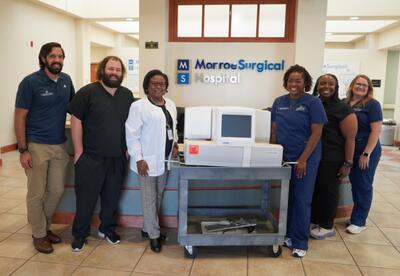
MONROE, LA – Louisiana Delta Community College (LDCC) proudly accepted the donati...


Monroe – In a continued effort to bridge the bayou, Louisiana Delta Community Col...
This site provides information using PDF, visit this link to download the Adobe Acrobat Reader DC software.